
It’s December: Can You Paint A House Exterior?
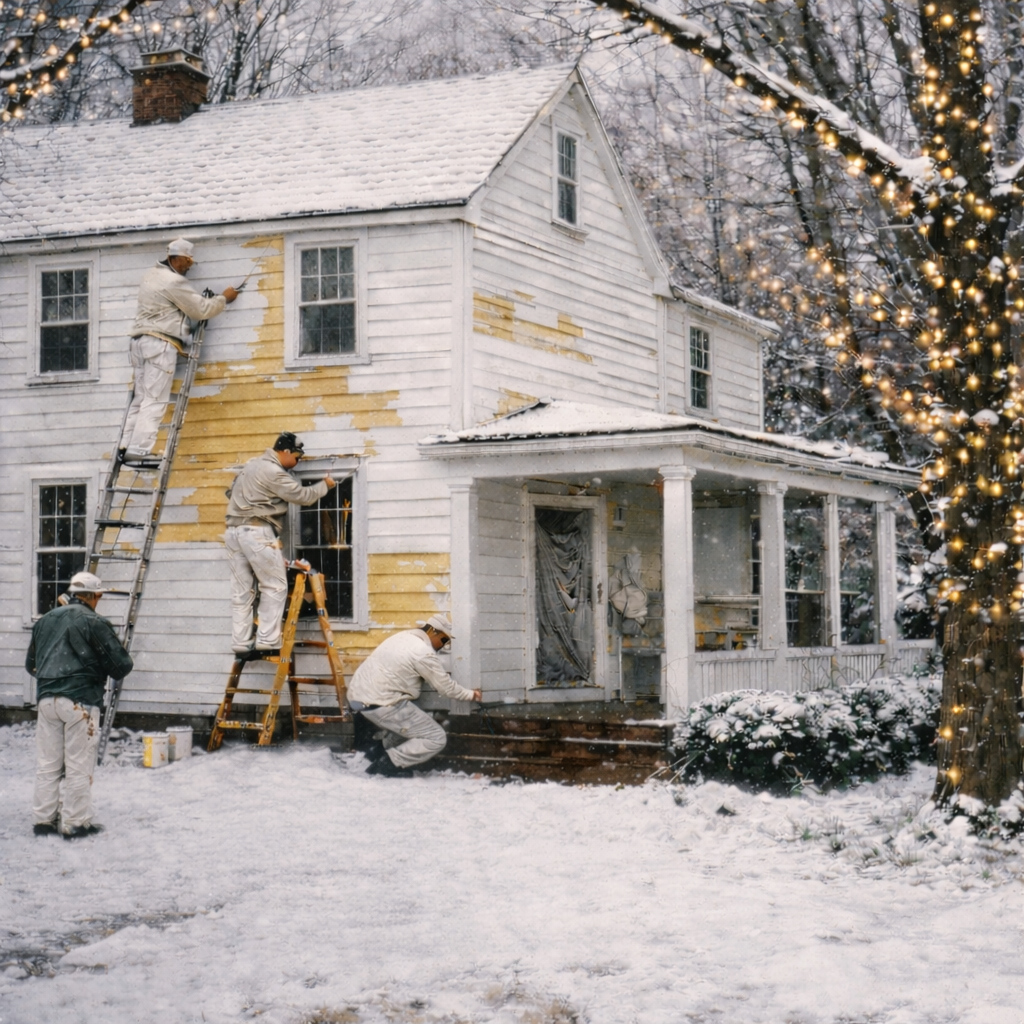
It’s that strange stretch of time between Christmas and New Year’s.
You’re home more often than usual. The calendar is unusually quiet and the house suddenly becomes very visible.
Outside, instead of snowdrifts and frozen ground, you see bare lawns, dry siding, and a sun that’s actually doing something.
By early afternoon, it’s pushing the high 30s. Maybe even flirting with 40.
And someone says it—half joking, half serious:
“Honestly… could we paint the house?”
It’s not a ridiculous question. In fact, it’s a very modern one.
New England winters don’t behave the way they used to. December can feel more like late February. March can feel like January. And when the weather doesn’t look like winter, the old rules quietly lose their authority. If it isn’t snowing, if the siding is dry, if the sun is out and the thermometer isn’t alarming, the question stops being theoretical. It becomes practical.
Not because homeowners think they understand paint better, but because the conditions don’t match the warning.
So let’s talk about it honestly.
The Real Answer Isn’t Yes or No
If you’re asking whether exterior painting is technically possible in December, the answer is: sometimes…yes.
Modern paint chemistry has come a long way. Several major manufacturers now produce exterior coatings designed to tolerate lower temperatures, higher humidity, and earlier exposure to moisture. These products exist because the old assumptions about weather no longer hold. Shorter windows, sudden shifts, and inconsistent seasons have pushed manufacturers to design paints that are more forgiving when conditions aren’t ideal.
From a purely technical standpoint, there are scenarios where paint can be applied safely in colder conditions.
But painting a house isn’t just about what can be done on a given afternoon.
It’s about what sustains during winter’s return. It’s about what transpires during freeze-thaw cycles. It’s about what you uncover in April, not what you perceive in December.
That’s where theory runs into reality.
Why This Question Even Exists
Twenty years ago, this wouldn’t have been a conversation.
Paints required warmer temperatures, longer cure times, and far more stable conditions. Winter exterior painting simply wasn’t on the table.
Today, companies like Sherwin-Williams and Benjamin Moore have developed exterior lines engineered specifically to perform better when conditions aren’t ideal.
That doesn’t imply they’re miracle products. It simply means they’re more forgiving, within certain limits.
Sherwin-Williams Cold & Inclement-Weather Options
Latitude® Exterior – Designed for lower application temperatures (down to roughly 35°F) and faster resistance to rain and moisture.
Emerald® Rain Refresh™ – Engineered to shed moisture earlier in the curing process.
Duration® Exterior – Known for flexibility and durability compared to older formulations.
Benjamin Moore Exterior Options
Element Guard ® - is a great example of why this question comes up: the paint can handle moisture sooner and tolerate lower application temps—but application isn’t the same thing as a winter-safe curing window.
Aura® Exterior – Can be applied at temperatures as low as ~35°F and offers excellent adhesion when conditions remain stable.
These paints are impressive. They solve real problems. And in the right window, they perform exceptionally well.
But paint specifications don’t tell the whole story, especially in New England.
Spec Sheets vs. Real Houses
Paint specifications are written in controlled environments: flat test panels, predictable surfaces, ideal prep and stable temperatures.
Real homes don’t behave that way.
Siding holds moisture differently depending on age and material. North-facing elevations stay colder longer. Trim shadows delay warming. Gutters, fascia, and lower boards retain dampness even on sunny days. What looks acceptable on paper can behave very differently on an actual structure—especially in winter.
This is where experience matters more than chemistry. A painter isn’t just reading a data sheet; they’re reading the house itself.
Dry Isn’t the Same as Cured
This is where winter exterior painting is most often misunderstood.
Paint doesn’t just need to dry. It needs to cure: a slower chemical process that creates durability, adhesion, and long-term performance. Curing depends on consistent temperatures, predictable humidity, and time.
Winter is unpredictable by definition.
You might get a beautiful December afternoon, followed by nights that dip well below freezing. You might avoid rain for a few days, only to run into condensation, frost, or sudden dampness that wasn’t in the forecast.
From the surface, everything can look fine.
Until spring…
What Tends to Show Up After the Thaw
When exterior paint is applied late in the season, problems rarely announce themselves right away. They show up quietly, weeks or months later.
Common issues include:
Incomplete curing before temperatures drop again
Adhesion failure caused by repeated freeze–thaw cycles
Early peeling or blistering in areas that looked perfect in winter
Recoat challenges when surfaces never fully stabilized
Moisture trapped beneath the film that only reveals itself once temperatures rise
This is the part homeowners don’t see when the job is finished—and the part professional painters worry about most.
A paint job that relies on luck isn’t a good paint job.
The Quiet Question of Responsibility
There’s also a less visible consideration: accountability.
When a winter paint job fails, the cause isn’t always obvious and it isn’t always immediate. Peeling in May doesn’t automatically get traced back to conditions in December. But reputable painters think about that chain of responsibility before the first brush ever touches siding.
It’s not just about whether paint can be applied. It’s about whether the result can be confidently stood behind months later.
That long view is what separates careful work from rushed decisions.
Why Reputable Painters Tend to Say “Not Yet”
When Stanwich Painting advises against winter exterior painting, it isn’t because we don’t understand the products. It’s because we understand what comes next.
Manufacturer guidelines assume ideal conditions, but real homes face varying weather conditions. Short daylight hours reduce work windows, temperatures fluctuate, and moisture behaves differently. Moreover, once winter arrives, there’s no room for correction.
Professionals don’t just think about whether a coating can be applied…we think about whether it will still look right years from now.
Sometimes the most responsible decision is knowing when not to proceed.
What Winter Is Actually Great For
That doesn’t mean winter is a dead season for your exterior. In many ways, it’s the opposite.
Winter is one of the best times to:
Evaluate siding, trim, and existing coatings
Identify repairs before spring moisture exposes them
Plan color palettes without pressure
Schedule early and avoid the spring rush
Coordinate prep and carpentry where conditions allow
By the time warmer weather arrives, the homeowners who planned ahead aren’t scrambling: they’re already on the schedule.
So… Can You Paint a House Exterior in December?
Technically? In some situations…yes.
Professionally recommended? Usually not.
At Stanwich Painting, our role isn’t just to know what’s possible: it’s to make sure the work holds up. Exterior painting should be timed for durability, not convenience.
Sometimes the smartest move isn’t painting at all.
It’s getting ready and doing it right when the season truly turns.