
The Original House Painter: How a Once-Suspicious Trade Became Essential to the Home
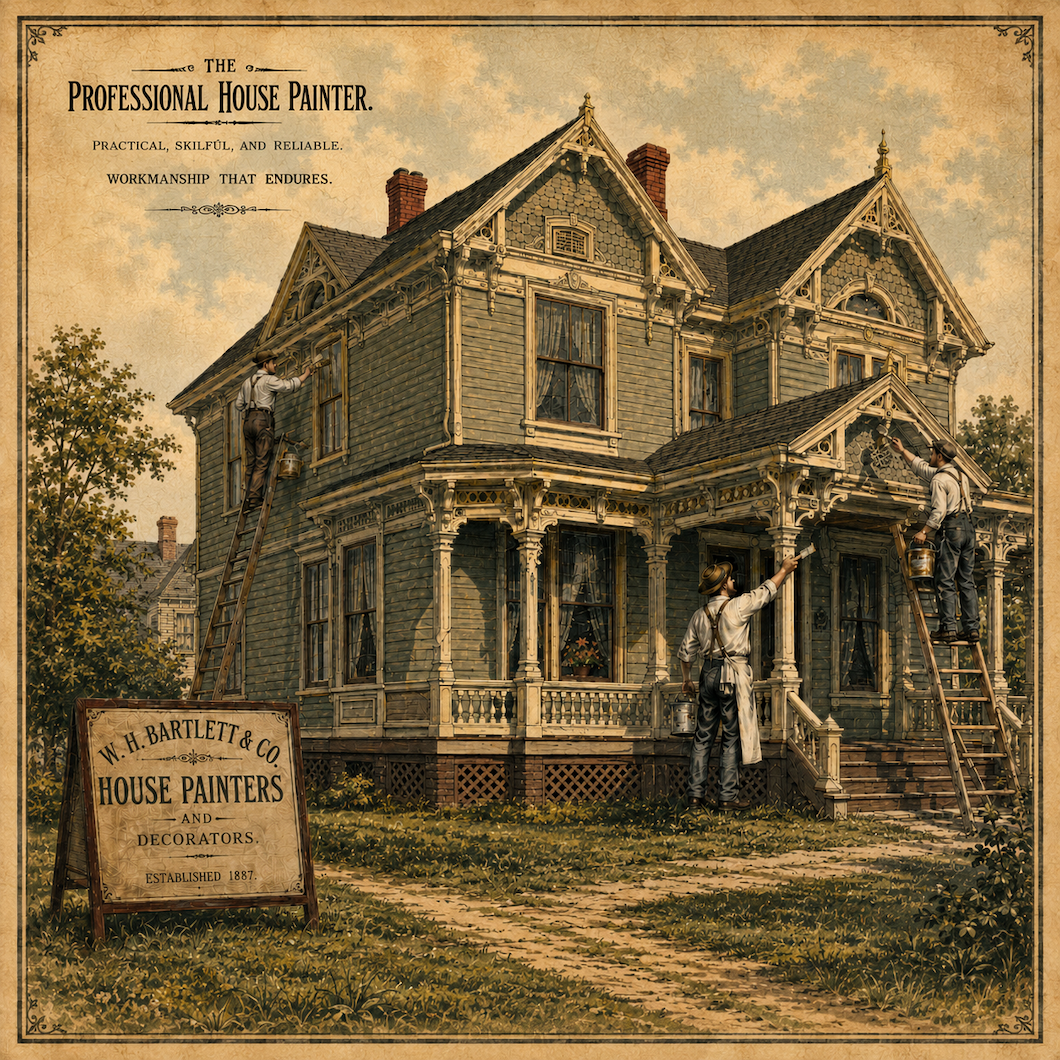
Today, hiring a house painter is a fairly normal act of responsible homeownership. An exterior starts to weather and lose its original luster. A front door needs a little dignity and a fresh coat to welcome visitors. The dining room color that once felt “bold” but now feels like it has been quietly arguing with the furniture for a decade…
So, you call a painter.
But the history of the house painter is stranger, older, and more revealing than most people realize. Before painting a home became associated with maintenance, design, resale value, or personal style, it carried deeper meanings. Paint was protection. Paint was status. Paint was craft. And, occasionally, paint was scandal.
One oft-repeated story from early colonial New England claims that in 1630, a Charlestown preacher was charged with sacrilege for painting the interior of his home—the act allegedly viewed as vanity and arrogance rather than simple decoration. The details are difficult to verify with certainty, but the story survives because it captures something true about the old tension around painted interiors: color was never just color. In certain times and places, to decorate a home was to say something about comfort, wealth, taste, and the human desire to make shelter beautiful.
In other words, the house painter has always stood at a curious intersection: part tradesperson, part artisan, part surface doctor, and part accomplice in the homeowner’s private dream of transformation.
Before Paint Was Pretty, It Was Practical
Long before paint charts, designer neutrals, and carefully chosen front door colors, humans were already applying pigment to walls. The earliest paints were made from earth, charcoal, minerals, and natural binders such as fat or saliva. Cave paintings used materials like ochre and charcoal, proving that people have been turning walls into expressive surfaces for tens of thousands of years.
Of course, a prehistoric cave wall is not a clapboard colonial in Fairfield County. But the instinct is related. A wall is never just a wall for very long. Eventually, someone wants to mark it, protect it, brighten it, soften it, or make it feel more human.
As buildings developed, paint took on a more practical role. Limewash, oils, pigments, and early coatings were used not only to create beauty but to protect surfaces from weather, moisture, insects, mold, and decay. That dual purpose still defines house painting today. A beautiful exterior is not merely cosmetic. Done properly, paint helps shield siding, trim, doors, and architectural details from the elements. A freshly painted interior is not only about color. It can also seal, refresh, clean, and preserve the surfaces that shape daily life.
The original house painter, then, was never simply someone who “made things look nice.” He was someone who understood materials.
The Painter as a Keeper of Trade Secrets
By the late medieval period in England, painting and decorating had become organized enough to support formal guilds. The Painters Company and the Stainers Company eventually merged in London in 1502, creating the Worshipful Company of Painter-Stainers. These guilds helped standardize the craft, protect trade secrets, and regulate who could practice the work.
That phrase—trade secrets—is important.
Before paint came pre-mixed in neatly labeled cans, the painter was responsible for understanding pigments, oils, thinners, driers, and surface conditions. A painter needed to know how materials behaved, how they aged, how they adhered, and how they reacted to different environments. The work required patience, strength, judgment, and a steady hand. It also required experience, because the “right mixture” depended on the job.
In modern terms, we might say the painter was part chemist and part craftsperson. But even that undersells the role. The painter also had to understand the social meaning of the work. A painted room, a decorated ceiling, a finished door, or a carefully treated façade could change how a building was perceived. Paint made a structure look cared for. It created atmosphere and signaled permanence.
That is still true.
When Paint Became Taste
The amusing thing about paint is that it always moves between necessity and desire. Nobody wants peeling trim, cracked plaster, stained ceilings, or weather-beaten siding. Those are practical concerns. But once the surface is repaired and ready, the conversation inevitably shifts.
What color should it be?
That is where painting becomes emotional.
Historically, painted surfaces often carried social meaning. A decorated home could suggest refinement, prosperity, or worldliness. In more austere religious or cultural settings, it could also be viewed with suspicion. Too much color, too much ornament, too much pleasure—the old fear of vanity was never far away.
Today, we may not accuse the neighbor of moral decline for choosing a high-gloss butler’s pantry, although there are probably exceptions in certain homeowners’ associations. Still, paint continues to carry meaning. A crisp white exterior can suggest order and tradition. A deep green library can create intimacy and intellect. A pale blue bedroom can imply calm. A black front door can feel formal, historic, or quietly dramatic. Even the decision to repaint after years of delay says something: this home is being cared for again.
That is why house painting is never purely technical. It touches memory, taste, identity, and aspiration. It changes how a house looks, but also how people feel inside it.
The Modern House Painter
The rise of manufactured paints changed the trade dramatically. Instead of mixing everything by hand on site, painters began working with standardized products, modern primers, specialty coatings, safer formulas, expanded color systems, and increasingly technical application methods. But the central skill of the professional painter did not disappear—it shifted.
Today, much of the best painting work happens before the finish coat is ever opened.
Professional painting involves careful preparation: repairing drywall or plaster, scraping loose material, sanding rough surfaces, filling nail holes, caulking seams, cleaning, masking, priming, and protecting the surrounding home. Modern descriptions of the trade still emphasize this preparation as a core responsibility of the professional painter.
This is where the old guild mentality still matters. The tools have changed. The products have improved. The color choices have multiplied beyond anything a medieval painter could have imagined. But the underlying truth remains the same: paint only performs as well as the surface beneath it allows.
A rushed paint job may look good for a little while. A properly prepared one has a different character. It sits better. It wears better. It respects the house.
The House Painter as Steward
In Fairfield County, where homes range from historic colonials and coastal cottages to new builds and carefully renovated estates, painting often becomes an act of stewardship. Many homes have architectural details worth preserving: original trim, old doors, plaster walls, exterior millwork, porches, shutters, and staircases that carry the memory of previous generations.
A good painter does not erase that history. A good painter helps it remain visible.
That may mean choosing the right primer for a difficult surface. It may mean repairing small imperfections before they become larger problems. It may mean understanding how sunlight hits an exterior in Greenwich, how moisture affects trim in coastal areas, or how an older interior wall needs more patience than new drywall. It may mean knowing when a bold color will elevate a room and when restraint will serve the architecture better.
The house painter’s role has always been larger than the brush. The painter stands between the home as it was and the home as it could be.
The Old Craft Still Matters
It’s easy to treat painting as the final step—the last coat, the visible layer, the satisfying reveal—but great paintwork is the product of planning, preparation, and care. From surface repair and priming to color selection and precise application, each phase matters. When every step is done well, the paint doesn’t just finish a project; it protects, enhances, and completes it.
But historically, painting has always represented something deeper. It protects the structure. It reflects the values of the people who live there. It carries the marks of craft, taste, restraint, ambition, and care.
Perhaps that is why the old suspicion around paint is so funny now. The Puritan fear of vanity feels extreme, but it recognized one thing correctly: painting a home is not a neutral act. It changes the feeling of a place. It declares that beauty matters. It admits that shelter can be more than shelter.
At Stanwich Painting, we see painting as both craft and stewardship: a way to protect the home while renewing the way it feels to live in it. Whether you are restoring an older property, refreshing a well-loved interior, or preparing an exterior for the seasons ahead, our team brings careful preparation, professional application, and respect for the surfaces that make each home unique.
To schedule a consultation, call 475-252-9500 or request a free consultation.
Stanwich Painting proudly provides top-quality residential painting services throughout Fairfield County, including: Greenwich, Cos Cob, Riverside, Old Greenwich, Stamford, Darien, New Canaan, and Wilton
Sources & Further ReadingThe Worshipful Company of Painter-Stainers — “History of the Company”
Best source for the medieval/guild history. It notes the Painter-Stainers’ history dating back to 1283, the merger of the Painters and Stainers in 1502, trade disputes with other guilds, and the company’s role in decorative arts and later wallpaper development.British Museum — Worshipful Company of Painter-Stainers biography
A concise, museum-backed source confirming the early painter organization, the stainers’ organization, their 1502 merger, and the 1581 Royal Charter. Good for a clean citation on the guild timeline.WebExhibits — “Pigments through the Ages: Prehistory”
Useful for the opening history of early paints, including cave paintings made from dirt or charcoal mixed with binders like spit or animal fat.Royal Society of Chemistry Education — “Prehistoric Pigments”
Helpful companion source for early pigments such as charcoal, soot, manganese oxide, and yellow ochre. Good if you want a more science/chemistry-oriented source for the pigment paragraph.House Painter and Decorator — Wikipedia
Fine as a general background source for the modern definition of the trade, preparation work, and historical overview, but I’d treat it as supplementary rather than the main historical authority.L.W. Winslow Painting — “Brief History & Evolution of House Painting”
This is the source you found for the Charlestown preacher anecdote, plus a broad trade-history timeline. I would cite it only for the “oft-repeated story” angle, not as a definitive primary historical source.Shearer Painting — “History of Paint”
Another painting-industry source that repeats the Charlestown preacher anecdote and includes colonial-era paint recipe details like lime, oyster shells, iron oxide, copper oxide, milk, egg whites, coffee, and rice. Again: useful and colorful, but better framed as trade-history lore unless backed by a primary source.